

Should You Pay Off Your Mortgage Before Retirement?
Deciding whether to pay off your mortgage before retirement is a question many soon-to-be retirees face. Eliminating debt can bring relief and a sense of accomplishment. At the same time, keeping cash available for emergencies or new goals can be equally important.
There is no one-size-fits-all answer. The right decision depends on your finances, lifestyle, and long-term priorities. As you evaluate your options, it helps to weigh the benefits, trade-offs, and planning considerations carefully.
Reasons You May Want to Keep Your Mortgage
In some situations, holding onto your mortgage can support flexibility and long-term growth. Liquidity, tax strategy, and investment opportunity cost all matter. Consider the following factors before using a large lump sum to eliminate your loan.
- Liquidity and flexibility. Money used to pay down a mortgage becomes difficult to access. If you later need those funds, you may have to sell, refinance, or open a home equity line of credit, which may not be ideal in retirement.
- Higher-interest debt should come first. If you carry higher-interest obligations, prioritize those. Paying off high-interest debt is equal to earning a guaranteed, tax-free return.
- Potential prepayment penalties. Some mortgages charge a penalty if paid off within the first five years. Penalties often range from 1–3% of the remaining balance or a set number of months of interest.
- Mortgage interest deductions. Interest paid on loans used to buy, build, or improve a qualified residence, up to $750,000, may be deductible if you itemize.
- Investment opportunity. If your rate is low, for example 3–4%, you may achieve higher long-term returns by investing. The larger the gap between your return and mortgage rate, the stronger the case for investing.
- Retirement catch-up contributions. If you have fallen behind in your retirement account, maximizing catch-up contributions may offer greater long-term benefit. For 2026, IRA catch-up contributions for those age 50+ increase to $1,100. Catch-up limits for most 401(k), 403(b), governmental 457 plans, and the federal Thrift Savings Plan rise to $8,000, allowing total annual contributions of up to $32,500. Under SECURE 2.0, individuals age 60–63 may contribute up to $11,250 in catch-up amounts.
- Tax planning flexibility. Maintaining a mortgage may help preserve tax-advantaged assets and allow for more strategic income management in retirement.
Reasons You May Want to Pay Off Your Mortgage
For others, eliminating the mortgage provides stability and peace of mind. Reducing fixed expenses can strengthen retirement security, especially in the early years.
- You have little or no other debt and no high-interest balances.
- You maintain a substantial emergency fund covering at least twelve months of expenses.
- You need to reduce monthly expenses to improve cash flow.
- Your mortgage rate exceeds your expected investment return.
- Lower fixed expenses may help reduce sequence of returns risk early in retirement.
- You want protection from income shocks, such as early retirement, health issues, or market downturns.
- Eliminating the payment could allow you to delay Social Security and secure higher future benefits.
- The psychological relief of being debt-free outweighs potential investment upside.
- Debt reduction provides a guaranteed benefit, while investment returns are uncertain.
Other Planning Considerations
Before making a final decision, examine where the payoff funds would come from and how this move fits into your broader retirement strategy.
- Tax implications. Using cash savings differs significantly from withdrawing from a 401(k) or IRA. Retirement account withdrawals are taxed as ordinary income and may push you into a higher bracket. If you are under age 59½, a 10% penalty may also apply.
- Future housing plans. If you plan to relocate or downsize, those funds may serve as a down payment. With 30-year mortgage rates near 7%, flexibility matters. Remember to factor in moving costs, closing costs, and potential capital gains. Married couples filing jointly may exclude up to $500,000 in gains on a primary residence if ownership and use tests are met.
- Mortgage recasting. A recast allows you to reduce your monthly payment without changing your rate or term. Lenders typically charge a one-time fee and require a minimum lump sum, often $10,000 to $50,000.
- A balanced approach. Some investors choose to invest a lump sum while making additional principal payments each month. This method maintains market exposure while steadily reducing debt.
Inside the Numbers
Consider the following example to illustrate how the math can work.
Assumptions
Mortgage balance: $350,000
Interest rate: 3% fixed
Remaining term: 30 years
Mortgage payment: $1,476/month (principal and interest)
Investment return assumption: 6% nominal
Extra payment option: $500/month toward principal
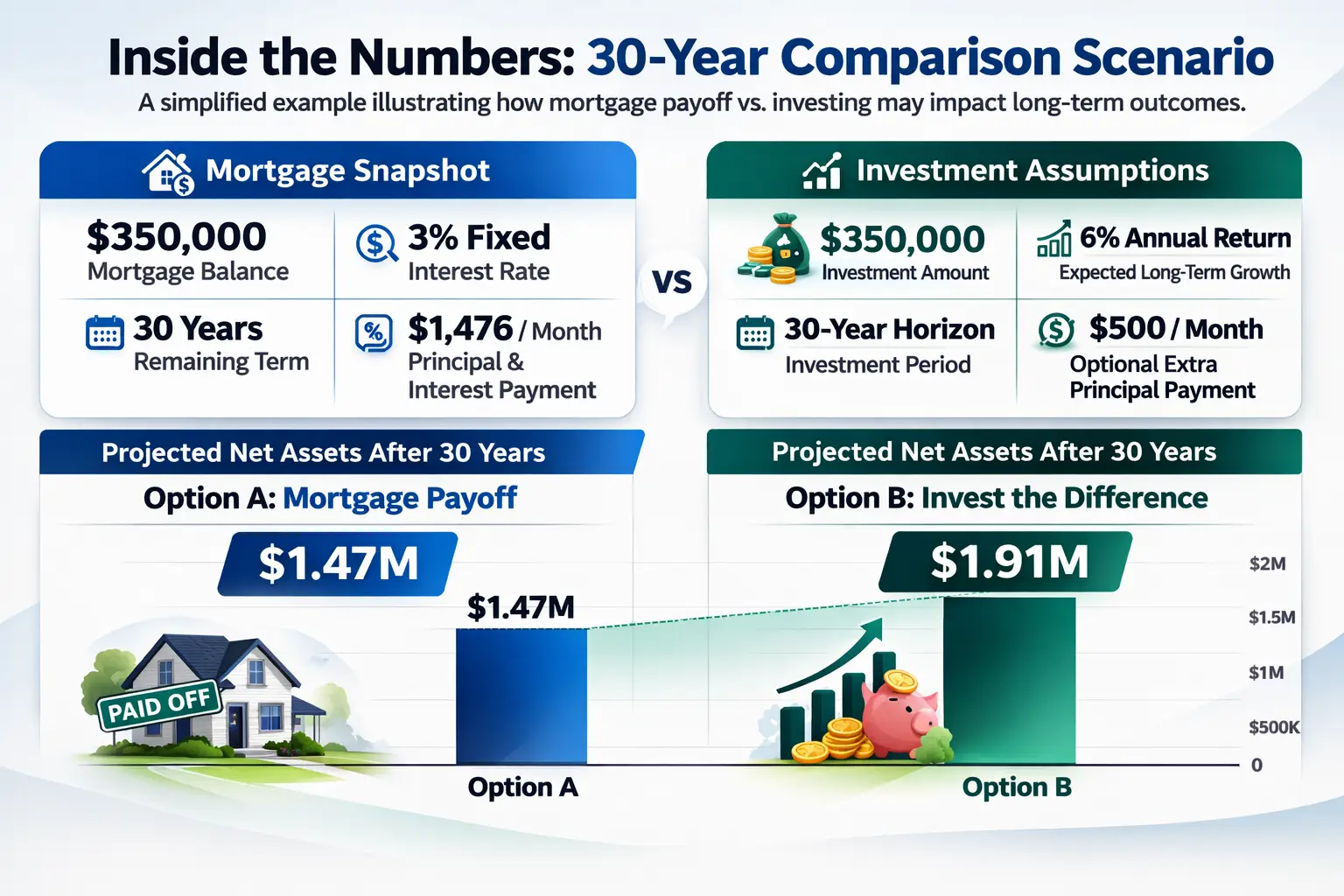
Table 1: Option A: Pay Off Mortgage
| Key Takeaways: |
|
| Financial Impact: |
|
| Benefits: |
|
| Drawbacks: |
|
Table 2: Option B: Keep Mortgage + $500 Extra/Month & Invest Remaining Amount
| Key Takeaways: |
|
| Financial Impact: |
|
| Benefits: |
|
| Drawbacks: |
|
After 30 years, Option B results in higher projected net wealth, approximately $1.91 million compared to $1.47 million under Option A. Compounding plays a significant role in the difference. However, projections rely on assumptions, and real-world results will vary.
Ultimately, the right choice depends on your financial position, risk tolerance, and retirement goals. A thoughtful analysis can help you balance growth potential with stability. If you would like guidance from a fee-only registered investment advisor fiduciary, contact us at 410-840-9200 or visit [www.mainstadvisors.com](http://www.mainstadvisors.com).
Main Street Advisors, LLC. February 2026. Main Street Advisors, Inc. is a Registered Investment Advisor. The articles and opinions expressed in this material were gathered from a variety of sources, but are reviewed by Main Street Advisors, LLC, prior to its dissemination. All sources are believed to be reliable but do not constitute specific investment advice. The views expressed are those of the firm as of February 2026 and are subject to change. These opinions are not intended to be a forecast of future events, a guarantee of results, or investment advice. Any advice given is general in nature and investors must consider their own individual situation. Always contact your financial/investment professional before making any financial decisions. Main Street Advisors, LLC, is not responsible for any damage or losses arising from any use of this information. Past performance is no guarantee of future results.
Sources:
Kiplinger. (January 31, 2025). Should You Pay off Your Mortgage Before Retirement?
https://www.kiplinger.com/real-estate/mortgages/is-paying-off-your-mortgage-before-retirement-a-good-idea
Rowe Price. (June 2, 2025). Should I Pay off My Mortgage Before I Retire? [https://www.troweprice.com/personal-investing/resources/insights/should-i-pay-off-mortgage-before-i-retire.html](https://www.troweprice.com/personal-investing/resources/insights/should-i-pay-off-mortgage-before-i-retire.html)
Forbes. (April 10, 2025). Pay off Mortgage or Invest: What Does the Math Say? [https://www.forbes.com/advisor/mortgages/pay-off-mortgage-early-vs-investing/](https://www.forbes.com/advisor/mortgages/pay-off-mortgage-early-vs-investing/)